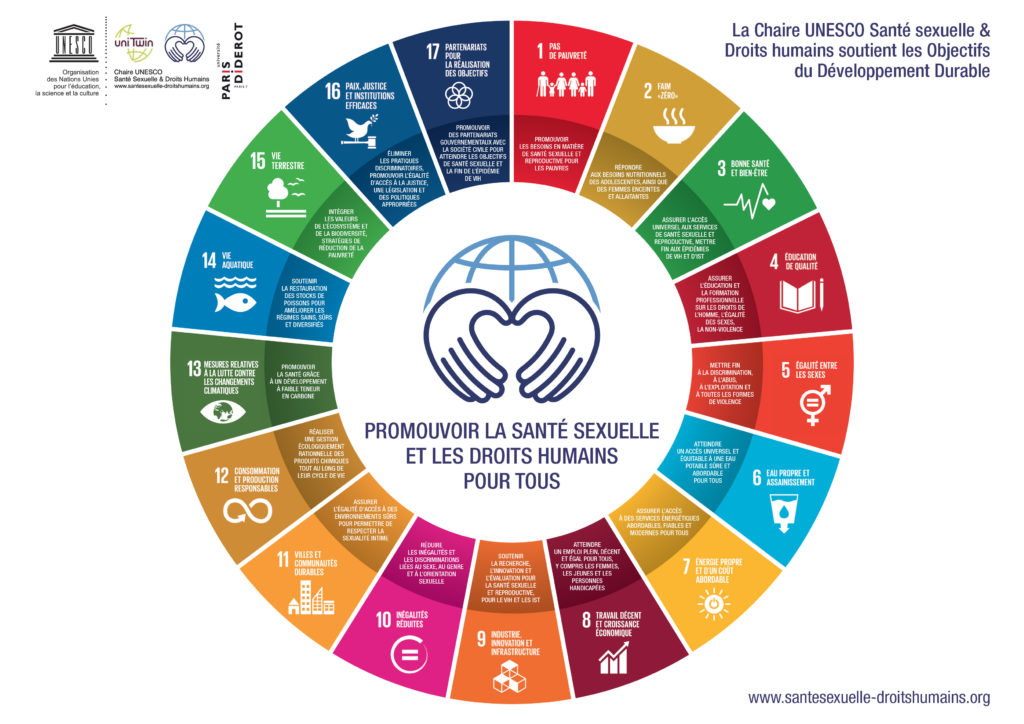
Sexual health is a fundamental aspect of human well-being that extends far beyond the absence of disease. It encompasses diverse dimensions, ranging from human rights and education to gender equality and sociocultural norms. This text aims to explore the issues surrounding sexual health, its importance within the framework of the Sustainable Development Goals (SDGs), and the need for adequate education.
1. Understanding Sexual Health
It is defined by the World Health Organization (WHO) as a state of physical, mental, and social well-being in relation to sexuality. It encompasses reproductive health and sexual rights, and manifests through social and cultural interactions. Sexuality is a fundamental right, and every individual must be able to exercise it freely and without coercion.
2. Sustainable Development Goals
The SDGs adopted after 2015 aim to promote health and well-being for all. Specific goals related to sexual health include:
- Objective 3 : end the HIV/AIDS epidemic and ensure universal access to sexual and reproductive health services by 2030.
- Goal 5 : eliminate all forms of violence against women and guarantee the autonomy of women and girls, particularly regarding sexual rights.
These objectives highlight the importance of sexual health education as an essential vehicle for achieving overall well-being.
3. The importance of sexual health education
Sexual health education plays a crucial role in disease prevention and in supporting individuals facing relationship challenges. It must be holistic and age-appropriate, covering topics such as interpersonal relationships, values and rights, and sexual behaviors.
4. Sexual rights as human rights
Sexual rights are an integral part of human rights, guaranteeing in principle that every individual has the right to access sexual health services, receive appropriate education, and exercise personal autonomy. This dimension is essential to ensuring that sexuality is experienced in a positive and fulfilling way.
5. Factors affecting sexual health
It is influenced by a multitude of factors, notably:
- individual : physical, psychological, and mental health, sexual orientation, gender identity.
- social : cultural norms, socioeconomic status, social networks, discrimination, inequalities…
- policies : legislation, public policies, and available institutional mechanisms.
Taking these factors into account is crucial for developing health policies that are inclusive and effective.
6. An inclusive vision of sexual health
To ensure it is truly accessible to everyone, it is necessary to adopt an intersectoral approach that includes all groups, including so-called vulnerable populations. This entails the continuous training of healthcare and social work professionals to guarantee high-quality support.
Sexual health is a key element of overall well-being. It requires an integrative approach, supported by public policies and appropriate educational programs. By promoting sexual health education and respecting sexual rights, we can contribute to a more equitable and healthier society.
Read the definition of holistic health
References
- WHO, Definition of sexual and reproductive health
- United Nations Sustainable Development Goals
This text highlights the issues surrounding sexual health, its definition, its importance within the framework of the SDGs, and the need for education and a human rights-respecting approach for lasting well-being. It was created using communication materials kindly provided by Mr Thierry Troussier, Holder of the UNESCO Chair in Sexual Health & Human Rights.